
Quick Reference
c.1929
Keach Farm
Buckland, MA
Oil on Canvas
Landscape
Sugaring
30" X 27"
Bess Oakford Hunter
N/A
Related Links
- See also the...
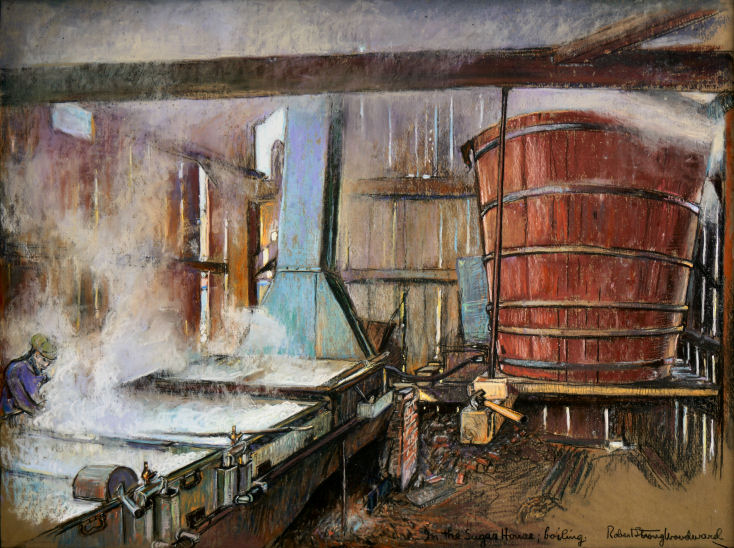 Sugaring Gallery to view related pieces.
- See also Maple Sugaring for a similar piece of work.
- See also the...
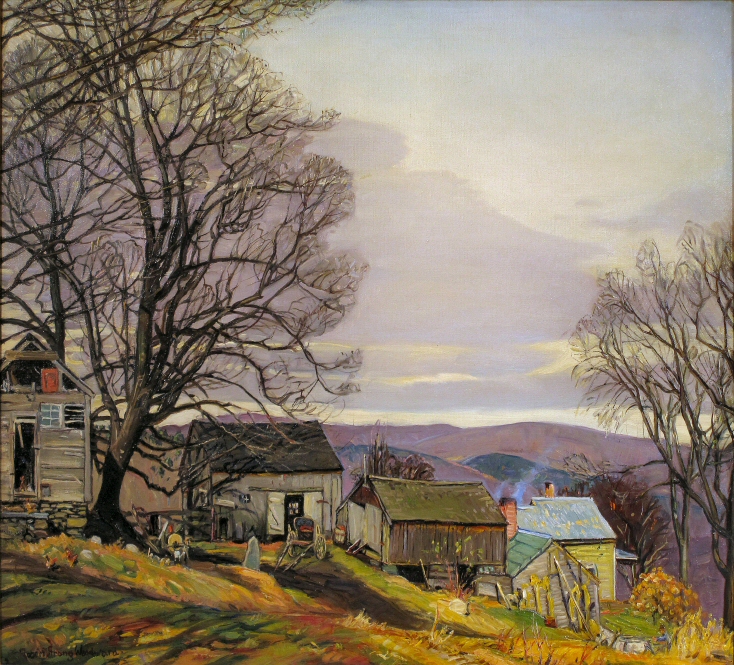 Keach Gallery to view related pieces.
- See also At Sugaring Time for a related piece of work.
- See also the...
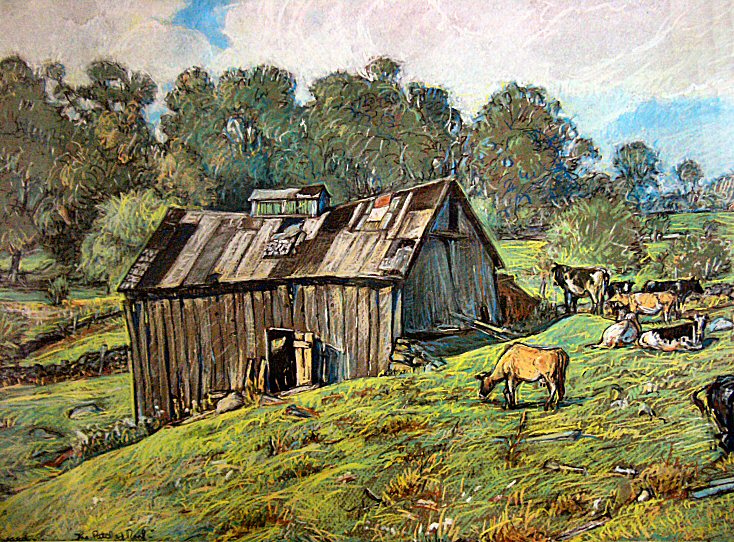 People & Livestock Gallery for related pieces.
- See also the Rocks & Stone Walls Gallery to view related pieces.
- See also the...
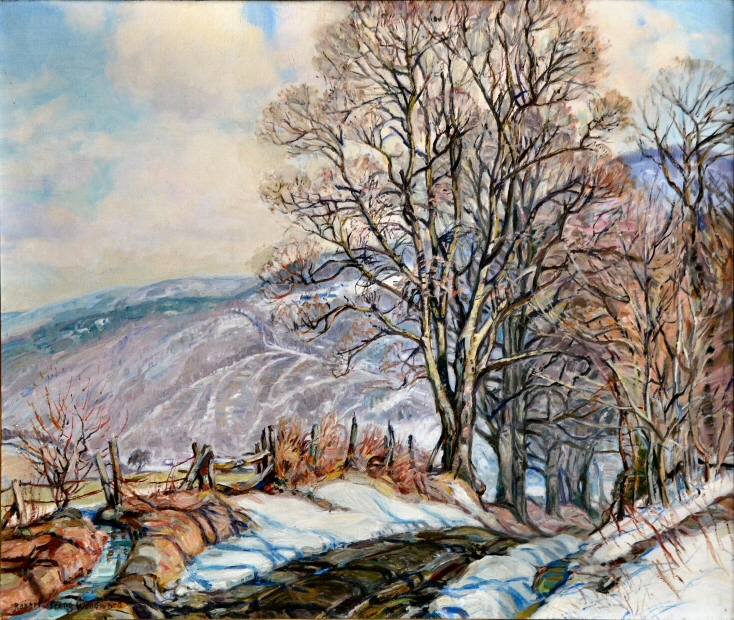 Roads & Streets Gallery to view related pieces.
- See also the...
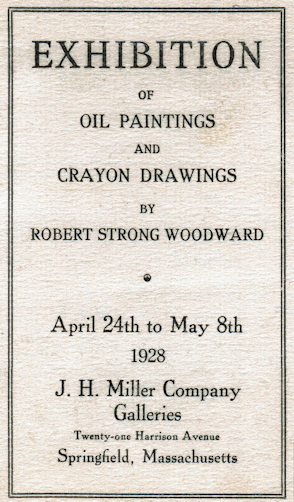 Exhibition List for a complete list of events
- See our page on ...
 the 1929 Littlecote Exhibit, Utica, NY.
- Stark New England
- Through Summer Hills
- Steaming Sugar House
- Winter Slope
- Noisy Brook
- Above The Valley
- The Flying Fox
- Dusty Rafters
- The South Window
- May Woods
- Read Mrs. H.R. Patch's Letters recalling her friendship with the artist.
- See also the...
 painting At Sugaring Time to view related pieces.
- As well as...
734.png) painting When Drifts Melt Fast. They both were made near by!
painting When Drifts Melt Fast. They both were made near by!
- See also the...
Sugaring Gallery to view related pieces.
- See also the...
Keach Gallery to view related pieces.
- See also the...
Roads & Streets Gallery to view related pieces.
.png)
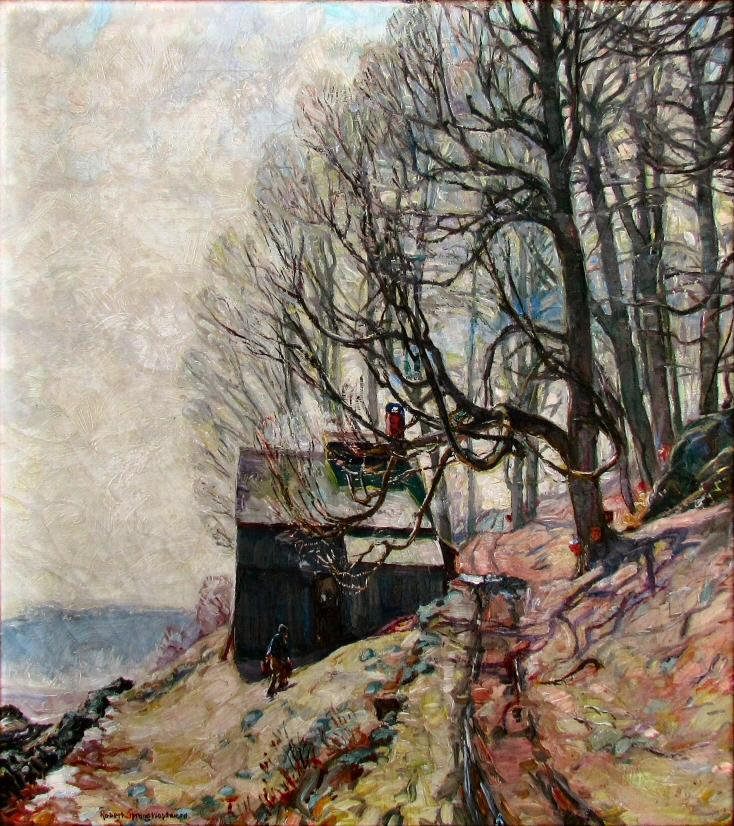
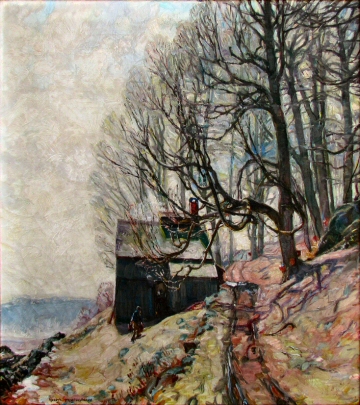
Featured Artwork: Steaming Sugar House
RSW's Diary Comments
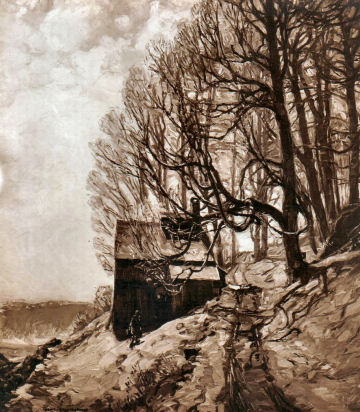
Original Sepia Print
"Painted prior to 1930. A favorite painting of Herbert Keach's sugar house on a steep hillside. Bought from the old studio around 1931 or 1932 by my old Peoria school friend, Bess Oakford Hunter. Hanging in their home. Mr. and Mrs. Jay T. Hunter, 304 Parkside Drive, Peoria, Illinois."
Comments on the back of a sepia print:
"The bright clean color of the pails and snow and trees in the crisp cool air... the trailing cloud of blue steam that makes such a lovely spot of color in the grove that climbs high up the hillside."
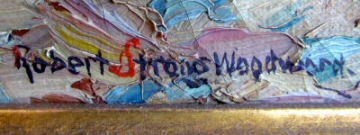
 Close up image of RSW's signature
Additional Notes
 This painting exhibited at two of Woodward's biggest shows of the late
1920's and mentioned in both of the newspaper clippings below. It was later purchased by RSW's childhood
friend and classmate at the Bradley Polytechnic Institute, Bess Oakford Hunter. Below we have included a
letter written by RSW in 1942 to her regarding the painting, old classmates and Bess' son well-being away
serving in the military during WWII.
This painting exhibited at two of Woodward's biggest shows of the late
1920's and mentioned in both of the newspaper clippings below. It was later purchased by RSW's childhood
friend and classmate at the Bradley Polytechnic Institute, Bess Oakford Hunter. Below we have included a
letter written by RSW in 1942 to her regarding the painting, old classmates and Bess' son well-being away
serving in the military during WWII.
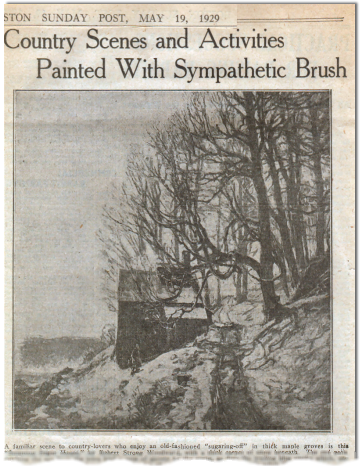
Clipping for Myles Standish Exhibition 1929
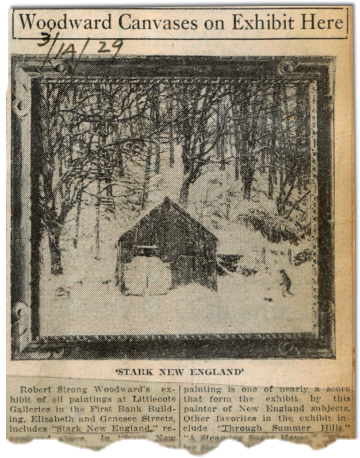
Clipping for Little Gallery Exhibition 1929
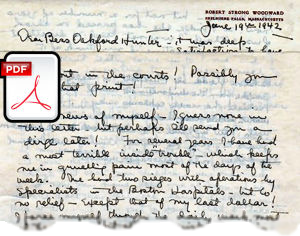
See also, this letter written by RSW to friend/ former classmate, Bess Oakford Hunter in
1942 (left).
✽ If you have trouble reading RSW's handwriting and would like to read a typed transcript of the letter please Click Here
❤ We wish to thank the current owner for contacting us and graciously providing us the (above) image of the painting, as well as the close up image of RSW's signature (right) from the lower left portion of the painting.
Click on image to compare Steaming Sugar House
side by side with Maple Sugaring
In January 2017 a recently discovered
painting named Maple Sugaring is similar to but different, in both
size and aspect ratio, from, Steaming Sugar House,. It is named and signed, however, the signature is
lacking RSW's trademark red "S". It is also different in brush style which is finer and not impasto like
Steaming Sugar House, (see above signature by RSW) suggesting it was painted later than this
piece.

Maple Sugaring, date unknown. In a unique way,
this painting is more revealing of the area.
Editor's Note: Addendum, Sept. 2024

A Google Maps screen capture of the area.
We continue to wonder about the oddity of the missing red "S" in the painting Maple
Sugaring. The initial assumption was that the painting was made AFTER Steaming Sugar House,
however, we now have a handful of paintings, painted around the same time with vastly different brush
techniques. For example, The Flying Fox was made the same year as Friendly Doorway (1924); along with A Country Interior and Country
Sitting Room (1928), in fact, if we did not know the date of The Flying Fox, we would date
it as a late 1930s painting! It was well before its time, so could it be that Maple Sugaring is the
older painting? Woodward did not begin using the red S consistently in his work until 1922. Still, he did
experiment with several variations on his signature but mostly signed paintings just as he did in Maple
Sugaring.
This painting is connected to several others all made from the same area of Avery and
Shepard Roads. The road you see in the painting above is probably Avery Road given how level it is. Shepard is
a steep up-down slope, however, a similar painting, When Drifts Melt
Fast, is made beneath the sap gathering men and their mules, that is most likely made from Shepard
Rd. looking up the hill. We know this because there is only one spot the Shepard brook is to the right of the
road as it appears in the painting, so it is the only place Woodward could be.
You can get a sense
of what we are talking about if you look at the Google Map screen capture to the right. We brightened the road
areas we think is where the paintings are made. That long squiggly line is the driveway / road up to the
Keach's Farm that literally clung to the side of a mountain, Snow Mountain, to be more specific. The gold star
on the map is the location seen in both Maple Sugaring and Steaming Sugar House and the orange star marks the location when
the artist positioned himself to paint When Drifts Melt Fast.
Bonus Material

A picture of the location where the sugar house
was that matches the landscape of both paintings.

A picture of the remaining foundation today. It is
hard to see in this view but should you enlarge the image
we provide you graphics to show the key area locations.

A picture of the stonewall and Avery Road. The
pile of rocks you see in this picture just off center to the
right are the stones of the rear foundation. The left is the
stonewall that to this day runs along Avery Road.
Herbert Keach's sugarhouse portrayed above is much like the whole farm, appearing to perilously be hanging for its life along a long slope. The farm itself was almost a fascination of Woodward's. We did the math. The bottom of the farm at Avery Road is 1,400ft and the top of it is 1,600ft. The length of the farm is 1,000ft giving it a grade of 20%. That is an incline of one foot for every 5ft of distance!

See Unnamed: Keach's
Drama for perspective.
We stress this because we often fail to think beyond the question, "Who in the world would choose
such harsh terrain to build a home and farm?" It seems ridiculous until some context is given, such as the
land was probably cheap and all the Keaches could afford. All of the more expensive, prime, fertile, flat or
at least flatter lands were either all taken up or too expensive, and it becomes clearer Woodward's
interest.
Many of you probably do not know that the artist's favorite subject, something he believed
to hold the key to understanding many social issues, was social economics. That area of study grew out of the
trendy belief at the time, "the survival of the fittest," which was borne of Darwin's Theories of Evolution.
While this trend focuses on the microcosm of the individual and their intelligence and background (race,
religion, gender), Social Economics focuses on the Macro, larger picture of circumstances and opportunity, as
well as situational supply and demand.
Those observing the "fitness" of the Keaches would say they
were fool-hearty or unintelligent... and judge them harshly. Even some of Woodward's friends, like Mrs. Helen
Patch, who laughed at the Keaches and called them "shiftless," which, if you do not know, means a combination
of lazy and unambitious. Woodward did NOT see them that way, especially after all he had been through. In
fact, we would say he identified with them quite a bit. The Keaches were "making do" with the resources they
had available to them and surviving even though it appeared precarious.
No matter how they were
doing it and under what circumstances, they were doing their best, and that, in the end, is all that matters.
There is dignity in that, and that is really the subtext to all of the artist's portrayals of area homes and
barns- that it does not need to be perfect to possess the grace of living and being alive. The Keach
farm exemplifies that in many ways and is astutely understood by the artist in a wheelchair.
