
Quick Reference
Painted 1932.
The Halifax House
Halifax, Vermont
Oil on Canvas
Landscape
Houses
27" x 30"
Salmagundi Club (NYC), 1932
Boston Art Club, 1932 ★
> Award: Second Prize Medal
Providence (RI) Art Club, 1932
Pittsfield (MA) Art League, 1932
Corcoran (DC) Gallery, 1932
Grand Central Galleries (NYC),1932
The Gills Gallery (Springfield), 1932
Stoneleigh-Prospect Hill School, '33
Providence (RI) Art Club, 1933
Williston Academy, 1933
Northfield Seminary, 1933
Stockbridge (MA) Public Library, '33
Amherst Coll. Jones Library, '34
Syracuse (NY) MFA, 1934
Springville (UT) Art Association, '34
Concord (MA) Art Association, '34
Binghampton (NY) MFA, 1934
Deerfield Academy, 1935
Mt. Holyoke Coll. Dwight Hall, 1935
Vose Galleries (Boston), 1936
Springville (UT) Art Association, '37
Francis Meredyth Whitehouse
NA
Related Links
- See also the...
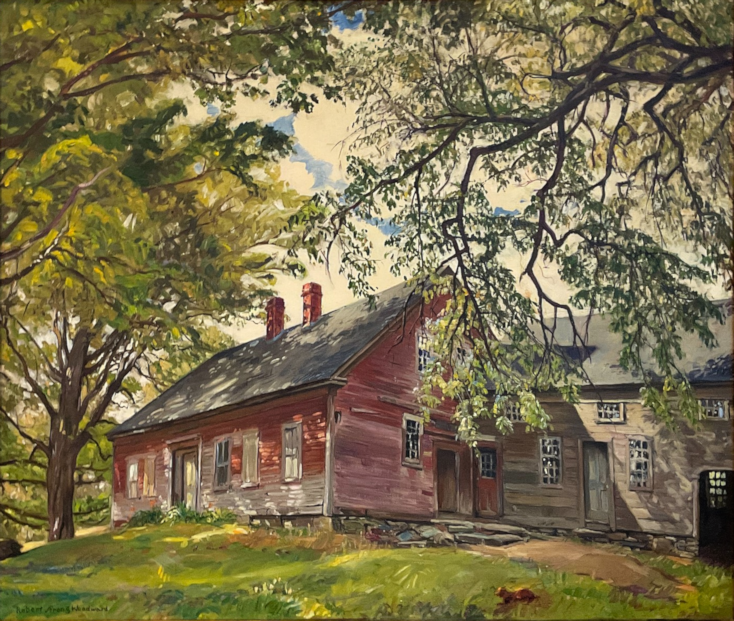 Halifax House Gallery to view related pieces.
- See also the...
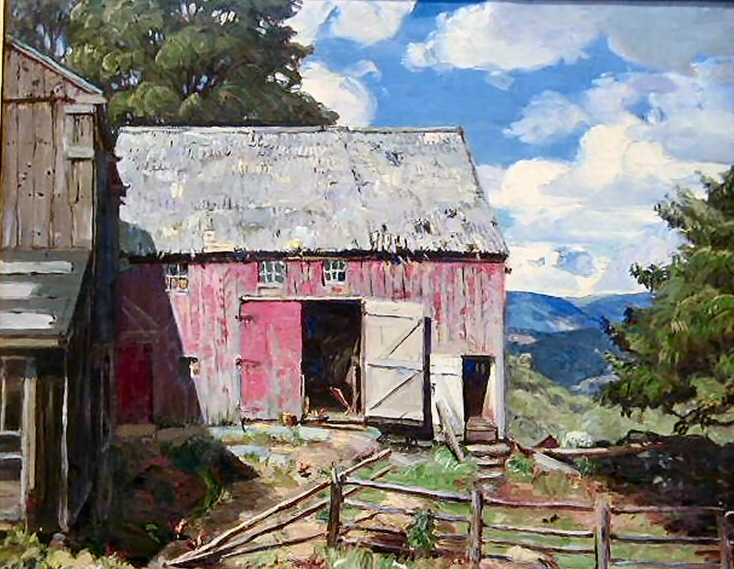 Barns Gallery to view related pieces.
- See also the...
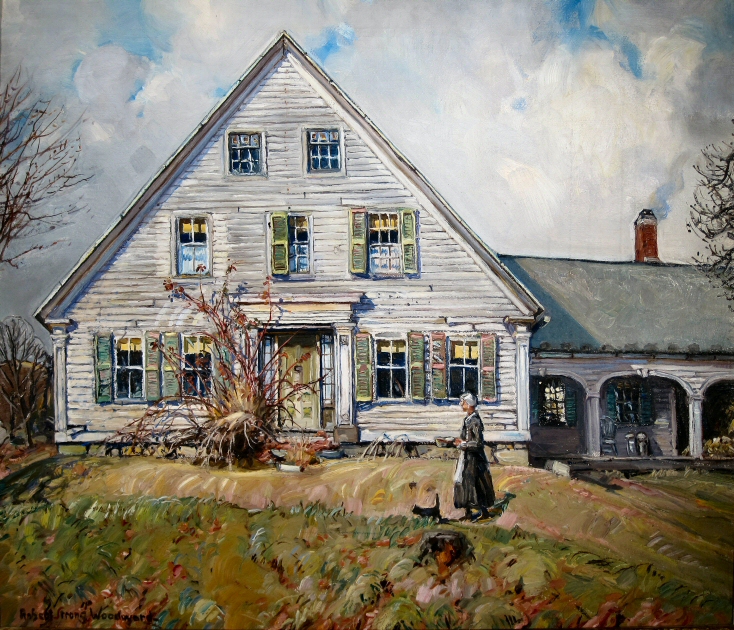 Houses Gallery to view related pieces.
- See also the...
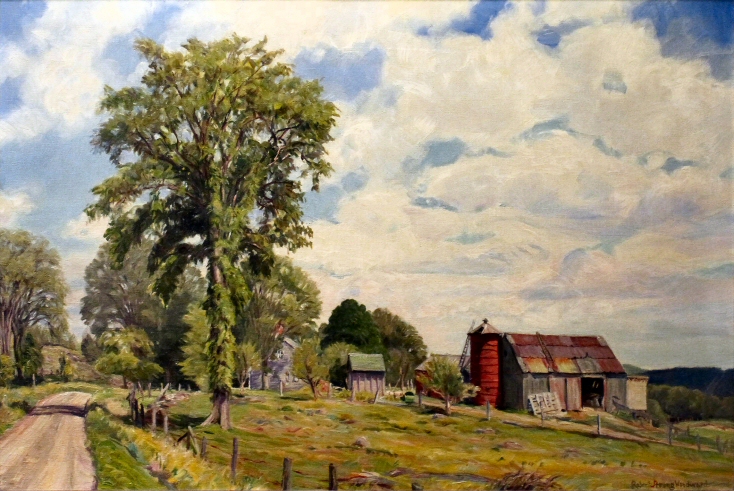 Farms Gallery to view related pieces.
- See also the...
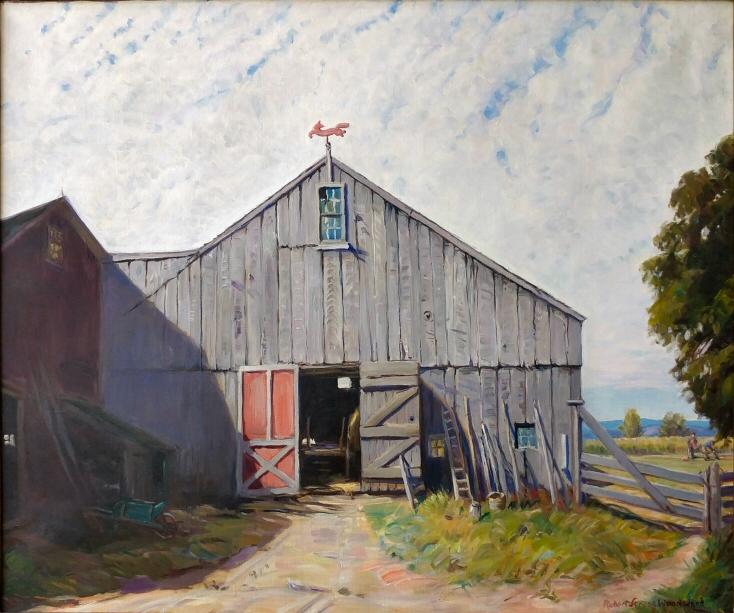 Fences, Gates & Doors Gallery to view related pieces.
- See also the...
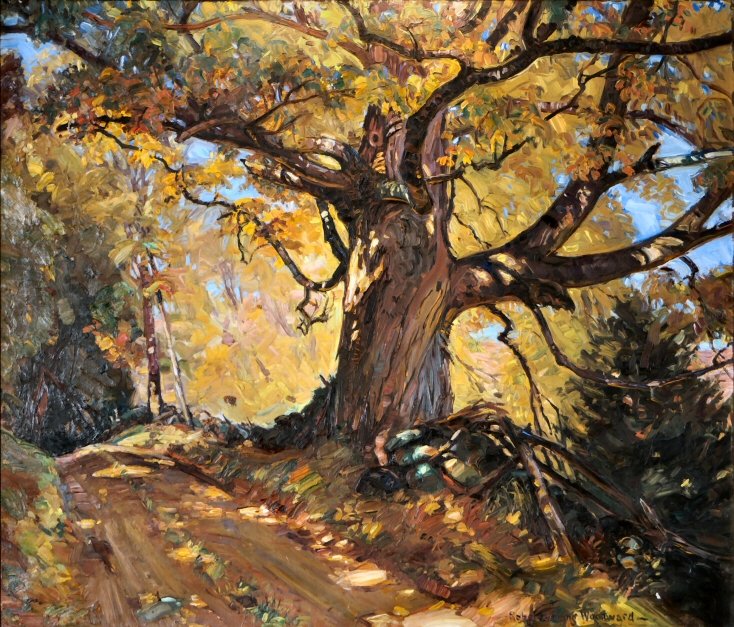 Trees Gallery to view related pieces.
- See our page devoted to...
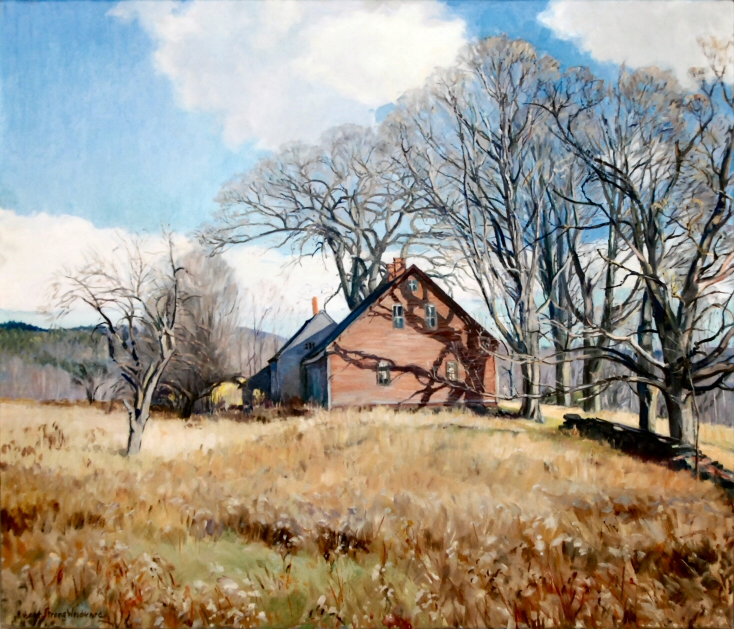 the Halifax House
- See also the...
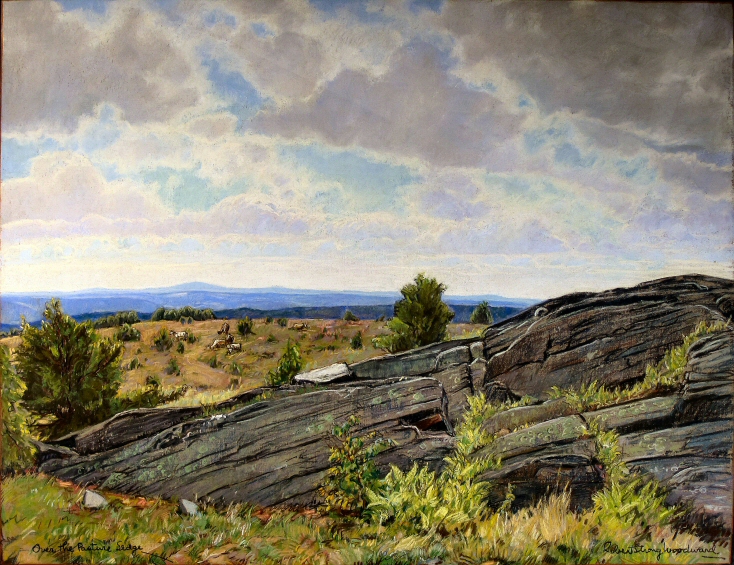 Rocks & Stone Walls Gallery to view related pieces.
- See also the...
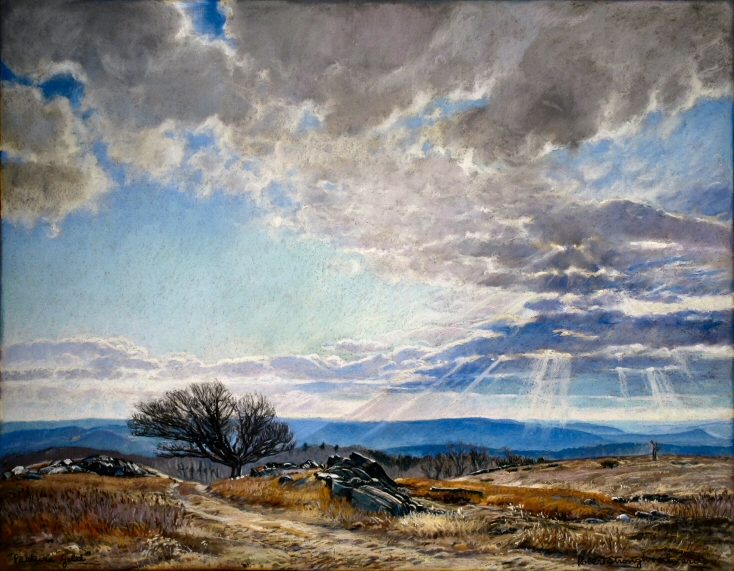 Stunning Skies Gallery to view related pieces.
- See also RSW's ...
 Famous Owners Gallery
- See also RSW's ...
 Personal Friends Gallery
- See also the...
 Exhibition List for a complete list
.png)
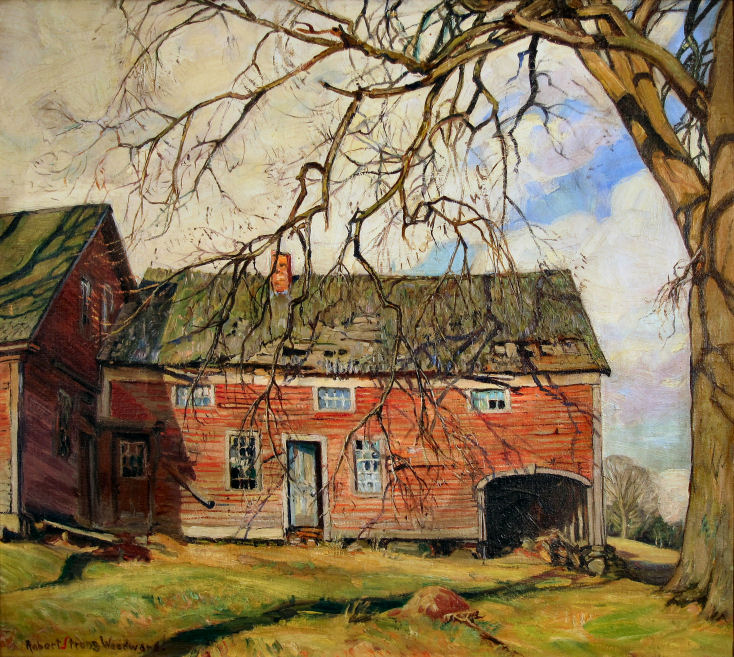
Featured Artwork: New England Heritage:  the first painting in the Halifax series...
RSW's Diary Comments
 When you hover over image, you can enlarge
the
image simply by clicking on it.
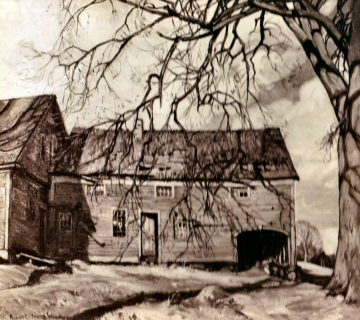
New England Heritage, Sepia
"Painted about 1930. The first painting I made of the old Halifax (Vt.) house, soon after I discovered it in the late summer of 1930, a house I painted many times after, from many angles. Exhibited quite largely, at the Boston Art Club Exhibition of Contemporary Art in 1932, being given second prize, with bronze medal. Purchased 1936 or 7 by Mr. Howard R. and Mrs. Helen Patch of 4 Barrett place, Northampton, Mass. for $400, May, 1936."
From Woodward notes:
"good reproduction of N. E. Heritage, BAC prize picture in the Post... was awarded second prize at the Boston Art Club Exhibit Contemporary American Oils. This artist has long been reckoned among American painters of original merit."
CORRECTION:
RSW did not begin to compile his paintings journal until the early 1940s. He did much of it from memory and on occasion, made mistakes. In the case of New England Heritage he mixed up his friends, the Patch's with his old bookplate client, Francis Meredyth Whitehouse. We have two sources confirming this: (1) from his own 1932 personal diary, RSW, enters a reference to a meeting with John Spaulding, Henry Clover Pepper and Whitehouse regarding Boston Art Club (BAC) business and notes that Whitehouse purchased the prize winning painting. The second (2) source is from Mrs. Patch's own recollection given to the Deerfield Academy's American Studies Group for their 1970 Catalogue and memorial exhibition. The Patch painting, she says, is titled American Heritage and the subject is actually related more to Dooryard Elm (the Burns & Allen painting) then this painting. We are still trying to locate American Heritage.
Additional Notes
New Information From RSW's Personal Dairy:
Besides learning that Whitehouse was the buyer of New England Heritage, we learn RSW
met with Whitehouse, Pepper and Spaulding to discuss Boston Art Club business. We have never been quite sure
about his status at the club, such as, what year he was permitted membership. We do know Henry Covey Pepper
was the controversial member of the Boston AC who chaired the exhibition committee that introduced the
non-traditional artist exhibit in 1918 that launched RSW's professional career. He was also well known as an
artist with a great interest in the Far East, particularly Japanese art. An attribute shared by Woodward!
Pepper would eventually move to Japan and live there for many years before returning to New England. Woodward
had plans to visit Japan in 1906 but it never happened because his accident occurred just weeks before he was
to leave.
What is more surprising is Whitehouse's involvement. We know that RSW made a bookplate for
his Crowhurst Estate on the Cape (plate etched by John Hudson Elwell).
Whitehouse was semi-retired at this time, but was one of Chicago's finest architects. He designed the
pavillion for the 1933 Chicago World's Fair art exhibition which would be under construction in 1932, the time
of their meeting. Woodward's A Country Piazza would be invited to
the fair by its curator, Robert Harshe, personally. Is this something, we ask ourselves? Mere coincidence or
another piece to the puzzle...
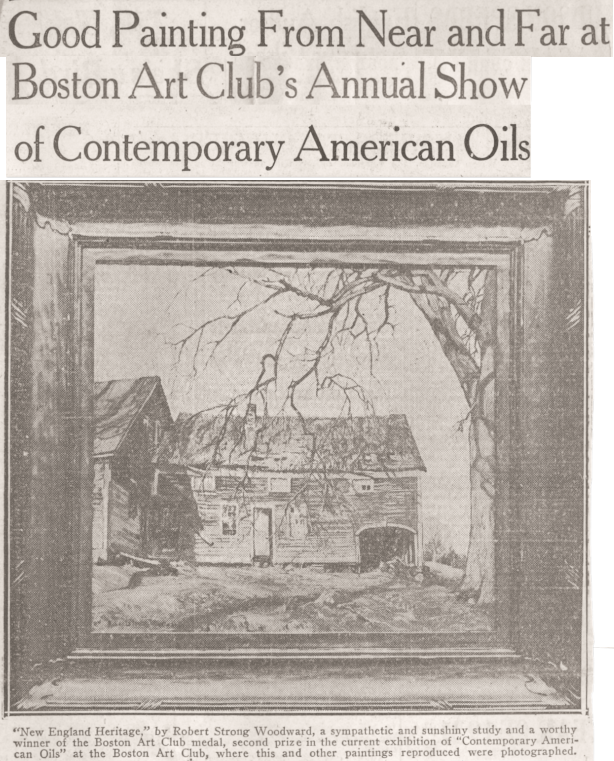
Feb. 07, 1932, Boston Sunday Post,
by Alice Lawton
Boston Sunday Post, February 7, 1932:
"... Beside it hangs New England Heritage by Rob-ert Strong Woodward, a sympathetic presentation of an old abandoned house, the sunshine mel-lowing its weather beaten red into cheerfulness, a nearby tree lowering graceful protective branches in pleasing pattern to screen its ruined roof; realism and poetry combined in genuine artistry. This, by a Massachusetts painter, has been awarded second prize."
"Art Chat" by Anna W. Olmsted, Director of Syracuse Museum of Fine Arts:
" ... What warm and delectable color in the weathered red barns, as in New England Heritage (another prize winner)...."
North Adams Transcript, Sept. 9, 1933
"Among his paintings is New England Heritage showing a dilapidated
red-painted ell with clinging clapboards and broken windows."
Bonus Material: the BAC 2nd Prize Award
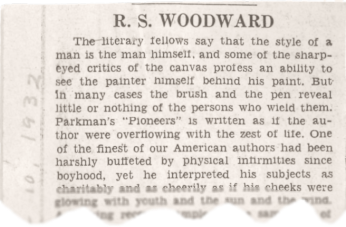
Feb. 10, 1932, Boston Herald
As a result of Woodward's prize at BAC
an editorial on Woodward by the actual
Editor of the newspaper was written.
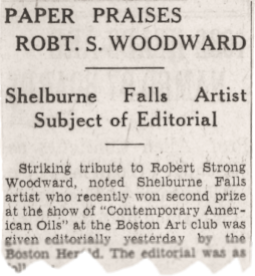
Feb. 11, 1932, N. Adams Transcript
The Editorial above was such a big deal
the next morning the North Adams Trans-
cript covered it as news and quoted it.
Editor's Notes:
 The Boston Sunday Post article by Alice Lawton needed to be
added to this page to offer context to the significance of this painting's second prize award at the Boston
Art Club. The annual event, held during the city-wide "Art Week" celebration is not just a local event. We
learn from Lawton that artist from all across the country are welcome to submit and that this particular year
from a ballot of club members 10 artist were invited to submit one painting bypassing the jury selection
process.
The Boston Sunday Post article by Alice Lawton needed to be
added to this page to offer context to the significance of this painting's second prize award at the Boston
Art Club. The annual event, held during the city-wide "Art Week" celebration is not just a local event. We
learn from Lawton that artist from all across the country are welcome to submit and that this particular year
from a ballot of club members 10 artist were invited to submit one painting bypassing the jury selection
process.
"The Art Club not only heartily welcomes contributions from other sections of the country but also each year designates by ballot 10 artists outside of this State to be invited to send one picture each exempt from jury."
Not only is the show small (just 57 paintings), the inclusion of artist from across the country and the club's selection process makes it more competitive. Unfortunately, Lawton never says how many of the paintings were from outside the region.
Also worth noting is that First Prize went to a nude
portrait. Over the years we have made note of Woodward's prizes and how many of them were behind portrait
paintings, the most popular art form of the time.
For example, at the 1930 Boston Tercentennial
Exhibition, three painters were awarded "Gold Medals;" Woodward for his landscape, New England Drama and the other two artist for their portrait
paintings. One sculptor also received a gold medal.
At the 1941 Corcoran Gallery in Washington D.C.,
Woodward's August Shade took 3rd Place in the event's popular vote.
Just 17 votes separated him from 1st Prize and 4 votes for 2nd prize (out of 10,000 votes total). Both the
First and Second Prize went to portrait paintings. First, lets acknowledge that 10,000 people visiting any
exhibition is extraordinary but for the top three vote getters to be separated by 17 of those votes is
exceptional.
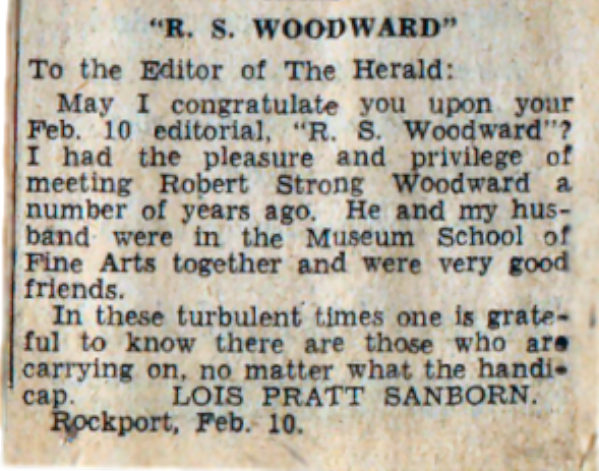
A response to the Herald editorial
by Lois Pratt Sanborn is wife of Rockport,
Maine artist
Earl Edward Sanborn a class-
of Woodward's at the museum of Fine
Art School in Boston, MA, in 1910.
The accomplishment of taking the 2nd prize honor at the BAC
prompted the Editor-in-Chief of the Boston Herald to write an editorial about the achievement and the spirit
of the artist with the North Adams Transcript printing an article the very next day reporting on the
editorial! Editorials are an exclusive club. A lot of discernment and discretion goes into what is
"editorial-worthy" and what is not. It maybe as high an honor as the award itself.
The editor
compares Woodward to famous historian, Francis Parkman who wrote the epic account of the migration westward,
titled, "The Oregon Trial" (1849). Parkman, also in a wheelchair since childhood wrote:
"...as if the author [Parkman] were overflowing with the zest of life. A striking recent example of the same sort of thing now comes to notice in the announcement that Robert Strong Woodward has won second prise at the show of -'Contemporary American Oils' at the Boston Art Club."
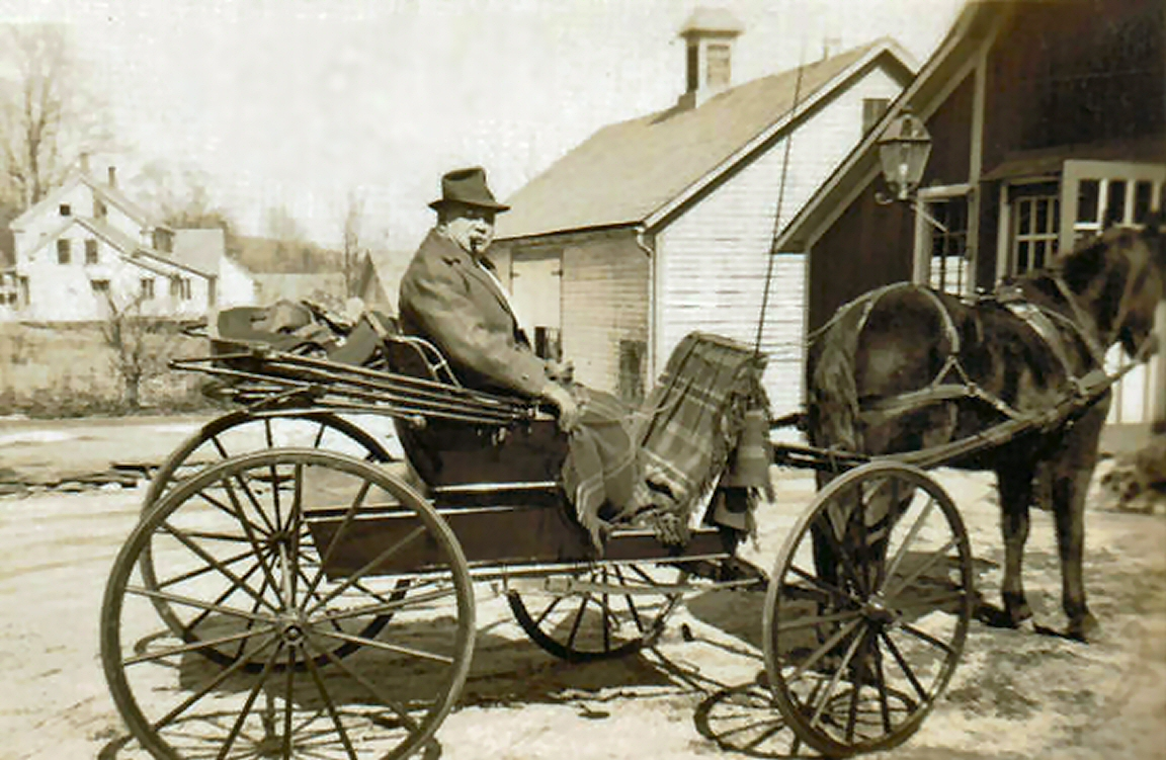
Woodward in his buggy sometime in 1934-'35 checking on the
process being made on his new home and studio Southwick. Note
that he is riding solo, something he did with more frequency than one
may realize. Read Morton Vose's funny recollection of one such time.
The Boston Herald Editor went on the say more in regard to Woodward's skill:
"Yet the Woodward paintings, his Berkshire trees, especially, have the power grace and brilliance which might glow from an energetic man, determined to tell people what a magnificent joy he has in paint-ing, and what glory can be snatch-ed from a bit of woodland."
We should point out that Woodward did not like the editorial, perhaps because of the editor's phrasing that assumes Woodward is not energetic. Nothing is ever that simple... He was full of life, vigorous and of course, energetic [see image to the right]. After reading the editorial, RSW made a note to a friend saying, "This was a lot of mush and sob stuff which I hate. Mother and Father, however, were very much excited." It is a shame that he could not overlook the ignorance of the editor and fully enjoy such an honor and praise.
HLN.png?url=photos/Newspapers/1932-03_02-SpringRep-LTE(Whiting)LG.png)
Mar. 02, 1932, Springfield Republican
Letter to the Editor from Margaret Whiting.
A Champion Emerges:
Out of this success, Margaret C. Whiting, gold medal winning needlepoint artist, designer, embroiderer,
preservationist, and co-founder of the The Deerfield Society of White and Blue Needlework (later evolving to
the Deerfield Society of Arts and Crafts 1899-1926) will carry a torch singing the praises of Woodward, most
notably, as an "American painter(s) of original merit" rather than the "pale imitators of foreign models" (we
imagine this might be a slight towards Grant Wood, painter of the iconic painting American Gothic
(1930). Wood painted in a distinctly Northern European Renaissance style where he studied for a period of
time).
Whiting would write at least five editorials advocating for Woodward's ascent to national
recognition. The first was to the Springfield Republican seen to the left who as far as we can tell failed to
note or cover the story at all. There was nothing in Woodward's personal scrapbooks that we could find. Not
that this means they didn't but our searches of both newspapers.com and newpaperarchives.com yielded nothing
either. She also wrote the Boston Post, the North Adams Transcript and the Hampshire Gazzette (Holyoke, MA).
We haven't processed them all yet and they were not yet available at the time of this writing. There is also a
letter to the editor of the New York Herald regarding a review given by its art critic Royal Cortizzos.
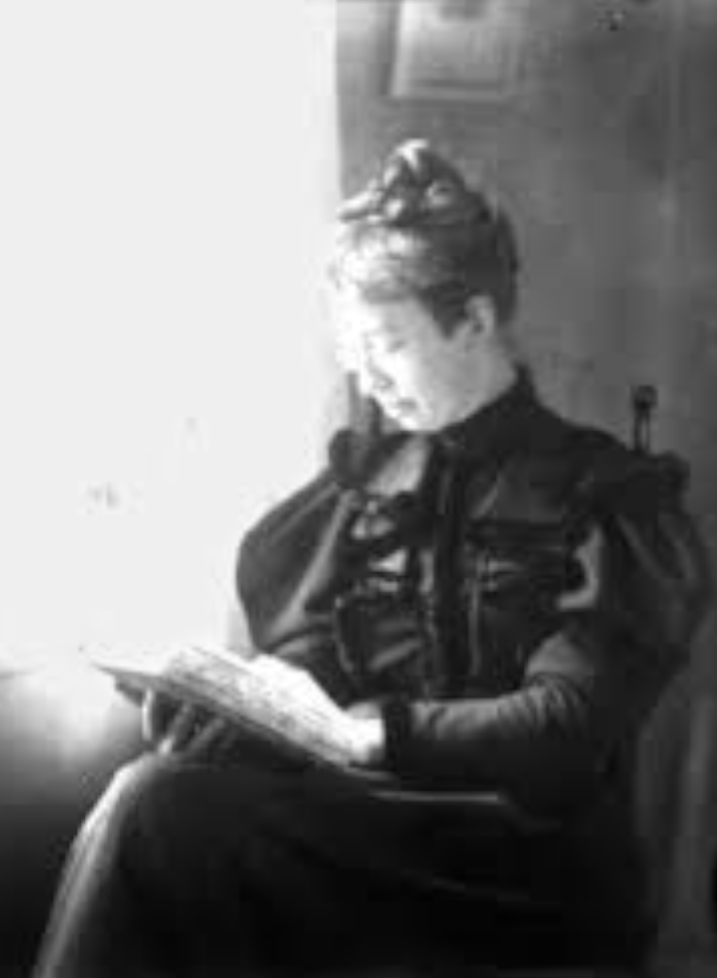
Margaret C. Whiting (1860-1946)
There is no question, Ms Whiting is an eloquent writer. We especially like how astutely and keenly she points out the key to Woodward's success:
"For his work is founded on the sincerity which is essential to all creative art, that clear truthtelling
of facts lifted into poetry by the painter's sensitive interpretation. Nature in all her moods. seen and
understood and set forth with robust and manly directness, unsentimental yet deeply felt."
Margaret
C. Whiting, Letter to the Editor of the Springfield Republican, Mar. 02, 1932
Although we have no physical proof Whiting and Woodward knew each other we also cannot see how they would not know each other. She was very involved in preservation, Deerfield, and the Memorial Hall Museum so it is hard to believe she would not also be involved with the Pocumtuck Valley Memorial Association (PVMA), also in Deerfield and linked to the Memorial Hall Museum to which Woodward was a member. In Fact, he mentions in his 1932 personal diary attending a meeting of the PVMA.