
Quick Reference
c. 1929
Colrain, Mass
Oil on Canvas
Landscape
Houses
25" x 30"
Myles Standish Galleries, 1929
Boston AC, 1930
Fitchburg Art Center, 1930
Cocoran Art Gallery, 1931
Concord AA, 1932
MacBeth Galleries, 1932
Chicago World's Fair, 1933 - '34
Pennslvania Academy FA, 1934
Dallas Museum FA, 1936
Albany Institute of Art, 1937
Myles Standish Hotel, 1944
Mr. Bartlett Arkell in 1933 for the
for the Canajoharie (NY) Museum
NA
Related Links
- See also the...
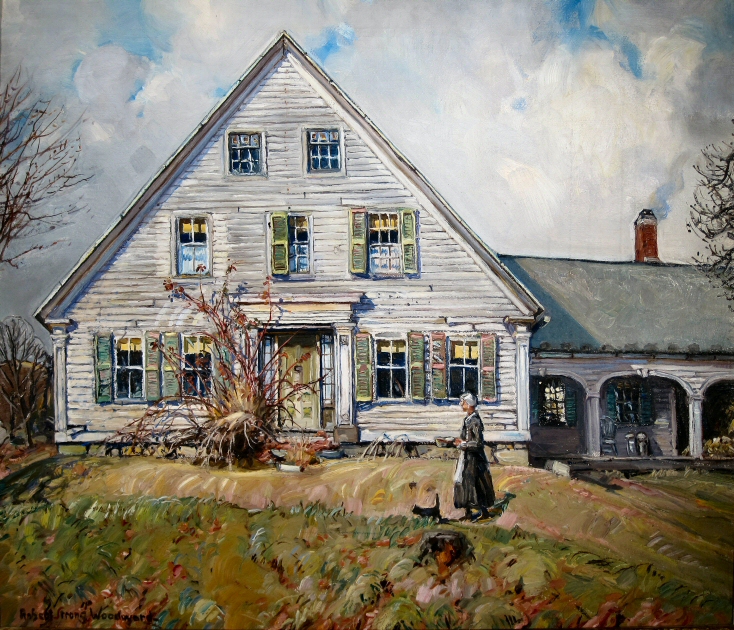 Houses Gallery to view related pieces.
- See also the...
 Scrapbook page devoted to Industrialist/Museum founderBartlett Arkell
- See also RSW's ...
 Famous Owners Gallery
- See also RSW's ...
 Personal Friends Gallery
- See also the...
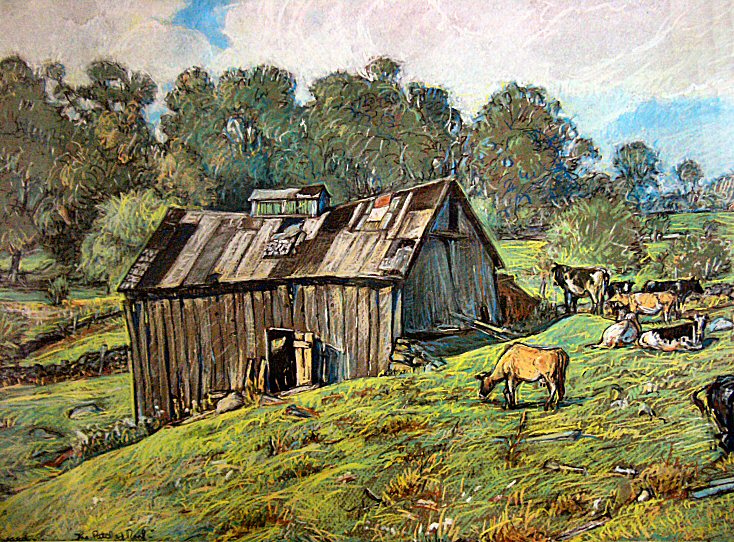 People & Livestock Gallery for related pieces.
- For more about the...
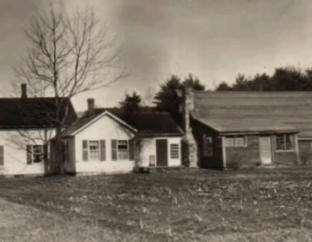 Hiram Woodward House & Studio, see our Scrapbook page.
- See also the...
 Exhibition List for a complete list
- See also the...
 Snow on the Ground Gallery to view related pieces.
- See also the...
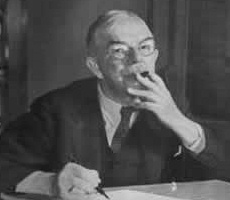 Scrapbook story on RSW's relationship with NYC art critic Royal Cortissoz
- See also our list of Woodward's owned by
 Public Institutions
- See our page devoted to ...
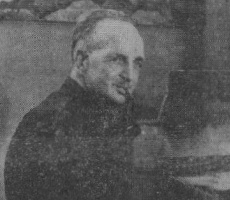 artist/friend Stanley Wingate Woodward
another Rockport artist.
.png)
Featured Artwork: Country Piazza
734WM.png)
RSW's Diary Comments
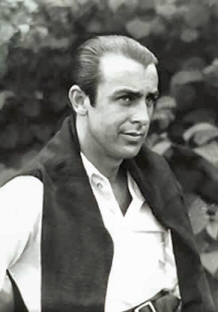
Artist, John Whorf with whom
RSW is referencing in this
diary entry.
"Painted in 1930. One of my most traveled and exhibited pictures. Painted of the Stowe farm, on Adamsville-North Heath Road the spring I lived in Purinton House, Colrain. Shown in leading exhibitions and invited by Mr. Harshe, to Chicago World's Fair exhibition. Illustrated in "Art News" as having had more wanderings than "Ulysses!" Bought from Macbeth Gallery by Mr. Bartlett Arkell and placed in his Canajoharie (N.Y.) Art Museum. A few years later this painting was copied almost "verbatim" in water color by the noted artist John Whorf, and illustrated in the N.Y. Herald Tribune --as Whorf's. I had considerable trouble over this with John Whorf and the Ferargil Galleries, N.Y.
(Editor's note: RSW was mistaken as the problem with John Whorf was actually with the Milch Galleries, not
Ferargil.)
Comments in a notebook by RSW: "Sold Dec. 1933--$450--33 1/3 com= $300"
Additional Notes
 "Mr. Harshe," referenced by RSW in his diary comment was director of the
Art Institute of Chicago (1921 to 1938), Robert B. Harshe, also the curator of the 1933 Chicago's World Fair
Exhibition.
"Mr. Harshe," referenced by RSW in his diary comment was director of the
Art Institute of Chicago (1921 to 1938), Robert B. Harshe, also the curator of the 1933 Chicago's World Fair
Exhibition.
It has been reported, though not yet confirmed, that RSW was the only New
England artist invited to the 1933 Chicago's World Fair Exhibition. Country Piazza was specifically
request and Harshe allowed Woodward to choose a second painting of his choice. Unfortunately, we do not have
the name of the painting Woodward selected.
It is believed that Harshe got to know of Woodward through prominent
educator and head of the University of Chicago art department, Instructor, Walter Sargent, who just happened
to be staying nearby at the Wayside Inn when Woodward exhibited 8 paintings at the home of the Johnson Farm in
Buckland, MA, in July of 1926.
We have an envelope from Harshe dated Nov. 6, 1932, but not the letter.
Woodward had a terrible habit of burning his correspondence. Thought he did keep some things of importance,
far more were destroyed.
Comments, Reviews & Quotes
Boston Globe, January 3, 1930 about an exhibition at the Boston Art Club by A.J. Philpott:
"Nothing has ever been painted with any more of loving care than Country Piazza by Robert Strong Woodward. That is a winter scene par excellence
Springfield Republican published a similar sepia reproduction, June 23, 1933:
"Country Piazza, a painting by Robert Strong Woodward of Shelburne Falls, on exhibition at the Century of Progress Fair, Chicago."
Boston Herald, August 20, 1933. A sepia reproduction of the above painting with the following comment:
"Hot Weather Hint: Country Piazza painted by Robert Strong Woodward of Shelburne Falls, Mass. and shown at the World's Fair. Something delightful to contemplate when the day is hot."
Greenfield Recorder, Jan. 6. 1934:
"Woodward's Country Piazza ...has just been sold to the Canajoharie Art Museum for its permanent collection.
The Breeze, June 5, 1931
"Country Piazza selected from the Corcoran Museum Show, in March, for reproduction in The Arts Magazine, is a genre picture of a house-corner and a lean-to shed. One member of the household is drowsing upon a settee. The milk pails are overturned upon their pegs, and three turkeys have ventured forth upon the melting snow. Even as Robert Burns lifted the genre songs of Scotland into the realm of poetry, so Mr. Woodward has given significance to a subject as plebeian as a snow-isolated farmhouse but as significant as the lives of those hardy wrestlers with the seasons who give sustenance to the world."
Boston Herald, Oct. 16, 1932
"Undoubtedly, the paintings are well arranged and there are a few high spots in the group. Robert Strong Woodward can always be relied upon to approach his subject in a forceful, straightforward fashion. In Country Piazza he has admirably caught the spirit of a small New Hampshire farm with piles of drifted and shoveled snow about the house, gaily feathered turkeys in the road and bunches of golden corn cobs suspended from the piazza roof. Anyone who has ever stayed at the Moody farm in Jackson will recognize 'Uncle Al' as the seated figure in the rocker. Geraniums in tins brighten the windows and the brilliance of sun and sky are reflected in the white clapboards of the house itself.
Boston Transcript, Oct. 1932
"His best work is a canvas previously seen in other exhibitions. It is called Country Piazza, and represents the side porch of a farm-house in the Victorian manner of 'ginger-bread' decorations, deeply banked with snow drifts. The painting, while conceding nothing to its companions in its reportorial function wears a softer mien.
New York Sun, Dec. 24, 1932
"Another canvas, called simply Country Piazza, is a close-up picture, apparently, of the same house, for it gives the snuggest impression of comfort, although the piazzas are almost eclipsed by the snowdrifts. The painting has no affectations, but is measured strictly to the themes.
Springfield Republican published a similar sepia reproduction, June 23, 1933:
"Country Piazza, a painting by Robert Strong Woodward of Shelburne Falls, on exhibition at the Century of Progress Fair, Chicago."
Website Curator & Editor Brian Charles on this painting:
An excerpt from an essay on Woodward's joy for "Waxing Poetic":
One of the first things we discovered in our closer examination of Woodward is that, though
often acknowledged by critics for his poetic aesthetic. He had a genuine passion for the marriage of
opposites (also called the sacred marriage) such as, combining the literal with the poetic. When the
literal is poetic in either a matching or complimenting manner it obfusicates its rationale and deepens
its meaning. This is the poetic aesthetic so often attributed to Woodward by critics.
Take for instance, the painting Country Piazza, featuring the ornate gothic porch, a
man lounging on a bench, and three turkeys in the front yard... The literal is that the wrap around porche
is called a piazza and this is a country home. The allogory is that the word "piazza" also means, "a
public square or marketplace," making the, man, a cat, and three turkeys poetically a gathering.
Going deeper, a group of turkeys is called a rafter and rafters are also the beams holding up that porch!
Public Squares are meeting places often ornately designed with remarkable architecture, like the gothic
corbels of this porch, (think Piazza San Marco, Venice, Italy one of the most famous gothic piazzs in the
world).
Woodward loved this sort of depth and meaning to things and whenever possible incorporated it into the
very fabric of much of his work. You will see just how significant this perspective is when, below, we
introduce a pervading perspective he used in a lot of his compositions to merge the near with the far in
an alternating style similar to that of a folding dressing screen.
We are not
suggesting any sort of master-plan-spy-craft-cloak-n-dagger stuff or, Dan Brown's Da Vinci Code treasure
map signs hidden in the art to conceal a conspiracy. It is not a puzzle to be pieced together and still at
the same time, it also does not mean that Woodward's seemingly innocent, pastoral, and beautiful paintings
of rural New England are devoid of a message with a specific context and commentary. He even editorialized
his unique perspective in a series of paintings he created from 1929 thru 1938. Country Piazza is one of
the first and is related to Contentment, Genial Old House,
Big Chimney, and his study of the abandoned the Halifax House.
The Controversy
New York Herald Tribune - Sunday, April 10, 1938
"Water Colors and Other Good Things"
By Royal Cortissoz [excerpt]
".....When John Whorf made his debut in New York a few years ago, at the Milch Gallery, he left for a young practitioner, an almost startling impression. He seemed to have taken over Sargent's accent in the use of water color to be uncannily skillful and confident. His nude figures are drawn against sylvan backgrounds reflected an amazingly matured technique. Subsequently the
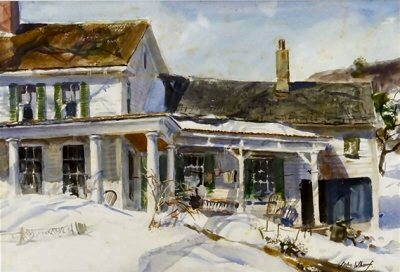
"Winter Morning" a Water Color by John Whorf
Sargent note faded away and he appeared to be in full possession of a style of his own. Today, coming forward again at the Milch Gallery, he achieves even more decisively effects pointing to individualized ability. If he has looked at the water colors of Winslow Homer the process has not obscured his purely personal gift. That gift is for the unhesitating and exact registration of the thing seen. There is nothing in the smallest degree photographic about his art, it is simply that he sees the truth and sets it down in unmistakable terms. Moreover, he sees the truth beautifully, so that he can take a prosaic subject like the snow- beleaguered house in the "Winter Morning" and make a charming picture out of it. This transmuted veracity of his is wreaked upon diverse themes, upon fishermen in their dories, upon sportsmen in their canoes, upon wildfowl rising into the air, upon simple landscape, and the thing depicted is always mad interesting. But I confess that what I have come back to again and again in this exhibition is just Mr. Whorf's expertness in the handling of his medium, the excellence of his draughtsmanship, the luminosity enlivening his color and the deftness with which he attains his purpose. It is a pleasure to observe the operations of so competent a workman."
Painted by John Whorf in 1938.
There was considerable correspondence between Robert Strong Woodward and Whorf about the similarity of the Whorf water color to to his own Country Piazza.
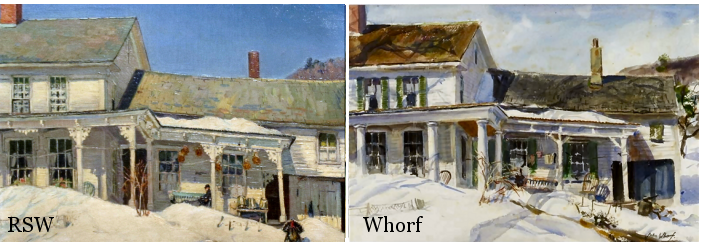
A Side by Side Comparison
Mr. Whorf apparently was known to copy other artist's work. To learn of another instance please read this
transciption of a 2005 Boston Globe article .
.