
Quick Reference
c. 1940
The Southwick Studio
Upper St. Buckland, MA
Oil on Canvas
Still Life
Window Picture Painting
20" x 40"
Yes, but not known where...
Unknown
N/A
Related Links
- See also the...
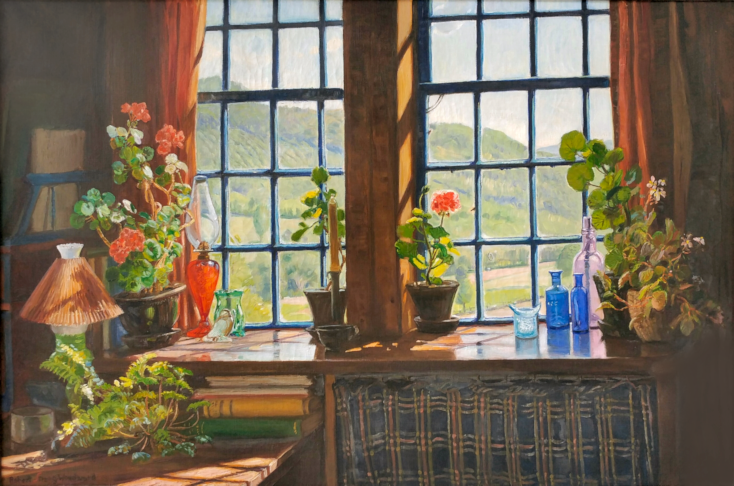 Window Picture Gallery to view related pieces.
- See also the...
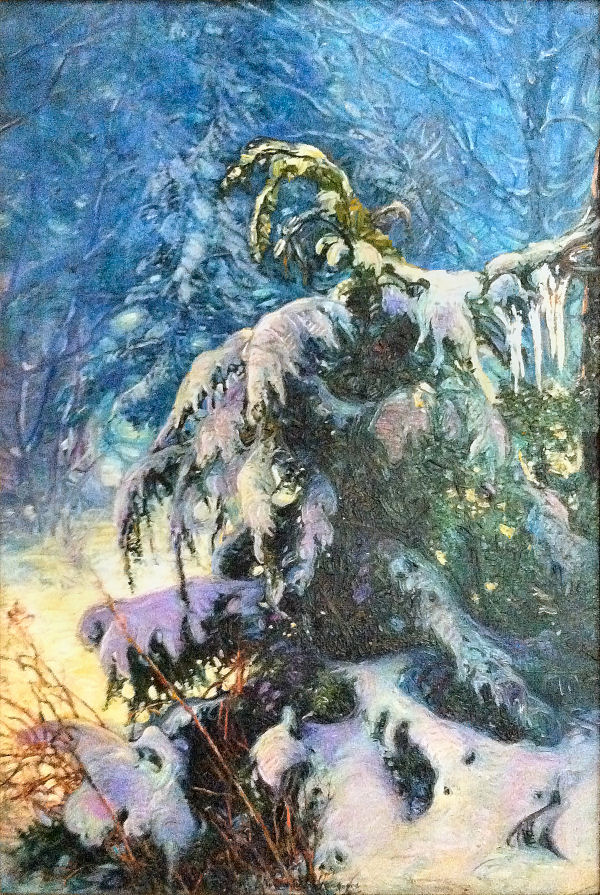 Snow on the Ground Gallery to view related pieces.
- For more about the...
 Southwick Studio Then and Now...
- See our page devoted to ...
 RSW friend, educator, and amateur photographer F. Earl Williams
- To learn more about the ...
 Studios themselves see our Scrapbook gallery page.
.png)
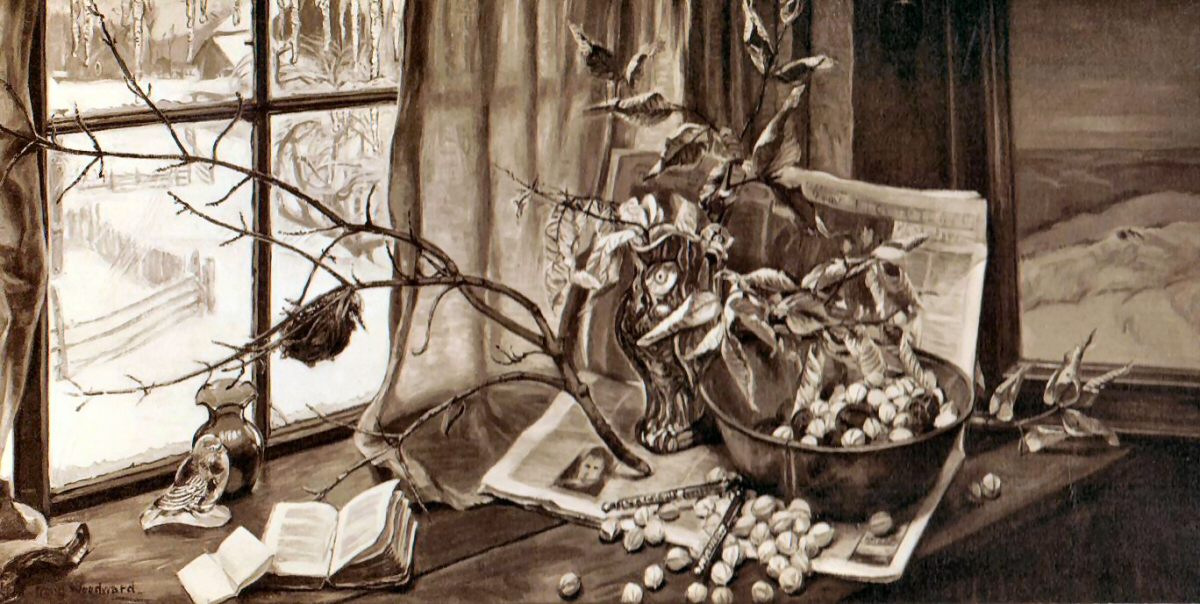
Featured Artwork: Unnamed: Winter Pleasures
RSW's Diary Comments
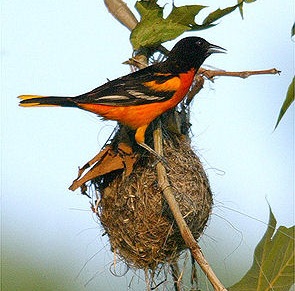
Baltimore Oriole and its nest.
Image courtesy of the Illinois Raptor Center
From the painting diary entry for Winter Pleasures:
"Painted about 1940. A long flat winter still-life arranged on the studio north window shelf, the snowy faint winter landscape showing through the window itself at the left hand side (gray curtains at the windows instead of the accustomed red), at the far right the frame and edge of a canvas showing in my display corner; on the shelf in between is grouped the still life of a tin pan of hickory and butternuts (with nutcracker on the shelf) my owl Majolica pitcher holding dried beech leaves, a bird's nest on a branch, a small dark blue glass vase with a pink paper inside it etc. etc."
Editor's Note from: Winter Pleasures
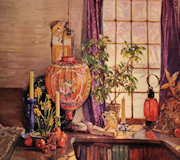
For this painting, we have many questions. The main question is if there are two paintings of this subject because the picture we (now) have does not match the sepia print used for years on the website. The painting appearing in Woodward's "display corner" in the image (below) is Portrait of a Shadow and the sepia is a winter heath pasture scene.
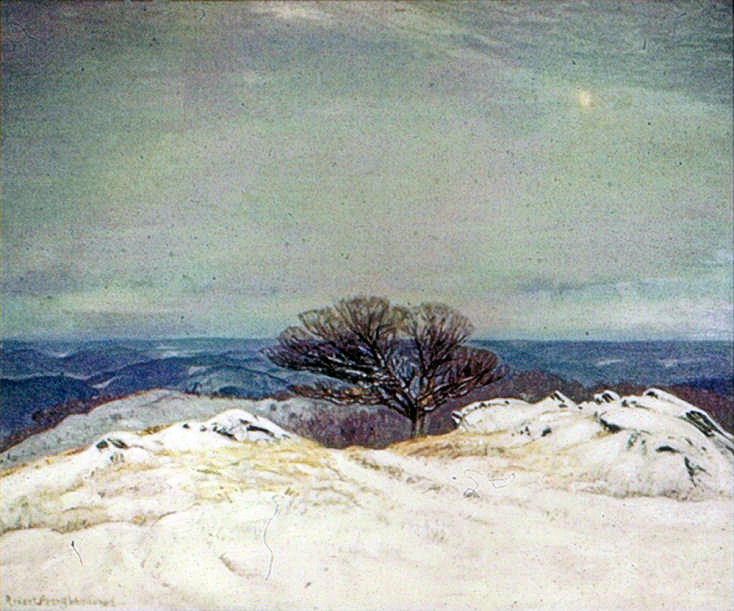
 More Snow Tomorrow, c. 1940
If you enlarge the picture, it will change to a side by
side comparison of the two canvases shared areas.
Editor's Note for this page:
We believe that the painting in the sepia print image
above is a painting named, More Snow Tomorrow. It was
not very hard to identify. If you look on the left side of that canvas you will clearly see very
distinct stone peaking through the snow covered ground that look like quotation marks (" ").
We have looked at every beech tree painting we have and this is the only canvas that matches what
little we see in the picture above. Also, More Snow Tomorrow fits the time period of the
painting diary remarks we have attributed to the named painting.
There is still the possibility there is just one painting. That Woodward changed the painting for Ms.
Garbose so it would be forever paired with the painting she bought prior, Portrait of a Shadow,
however unlikely it is. ⮟ continues below ⮟
734-ILL.png?url=photos/winter_pleasures(25)1200.png)
The canvas name Winter Pleasures does not match the sepia print by the same name.
Additional Notes
LG-stretcher.png?url=photos/winter_pleasures(25)LG-stretcher.png)
⮝ Here you can see the stretcher in the back with RSW's
handwriting naming the painting, etc. The fact a size and
price are offered and as seen in the lower image that it has
an item number and repeat of its size in the corner indi-
cates that it DID exhibit somewhere that required it. We
simply do not know where. There is no other record.⮟
LG-stretcher2b.png?url=photos/winter_pleasures(25)LG-stretcher2b.png)
To the left are two images of the back stretcher of the physical real-life canvas. In Woodward's
handwriting is the name, the size, and the price. This physical evidence trumps everything else.
The canvas with Portrait of a Shadow is Winter
Pleasures.
In the upper right hand corner of the physical real-life canvas is an item
number and size in someone else's handwriting indicating to us that the painting exhibited at a
large exhibition with multiple artist, like, the annual Art Week event in Boston's Jordan Marsh
Gallery, or the Southern Vermont Artist Association event held the week leading up to Labor Day
in Manchester, VT. There is the National Academy or Grand Central Art Galleries in New York City.
As for the canvas in the differing sepia print image, it would not exist if it too did not exhibit
somewhere. The sepia prints were often what was sent to upcoming exhibitions for the exhibit jury
to approve. By its own existence, it reasons that this slightly different painting also exhibited
somewhere under another name we do not know. The sepia print was mislabeled, probably by Dr. Mark.
He was familiar with the canvas because he worked for Woodward when it was made. However, as the
1940s went on, he served in the army and attended Oberlin College in Ohio for four years, so he
was not always there. He did continue to work for Woodward in the summers and when he was home
on break. Still, it is easily understood how the sepia, to him, was the one he knew and not that
there was a second canvas.
Demonstrating Dr. Mark's familiarity with this subject he mentions a little antidote about the nuts in the painting. Apparently, according to Dr. Mark, the painting was dubbed, "Ray's Nuts" for the nuts seen in the picture. A little humor between Woodward and the young man.
Dr. Mark's remarks on "Winter Pleasures" from the original website...
"This painting was dubbed 'Ray's nuts' after the hired man at that time brought the hickory nuts in for this arrangement."