
Quick Reference
c. 1925
Unknown
Oil on Canvas
Landscape
Landscape & View, Pastures
Unknown
Lyman residence, 1926
Unknown
NA
734.png)
.png)
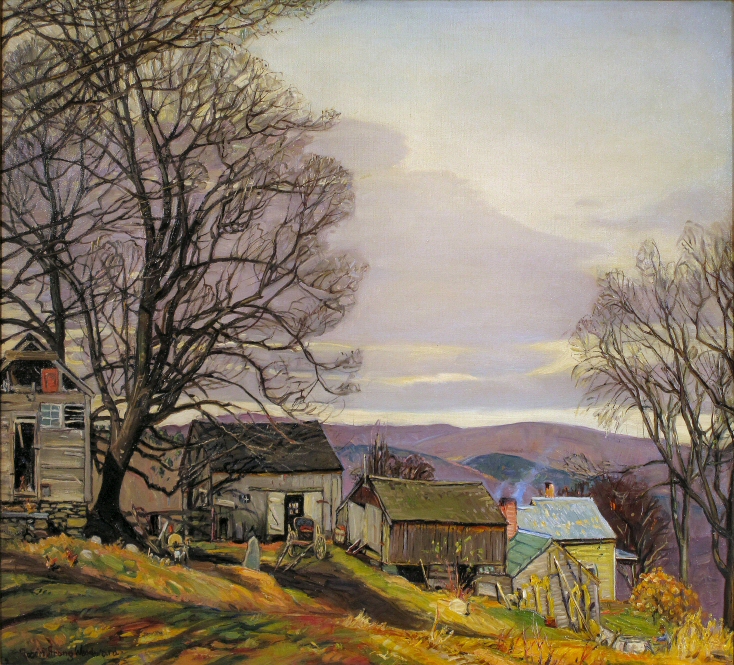
Featured Artwork: November Grey
RSW's Diary Comments
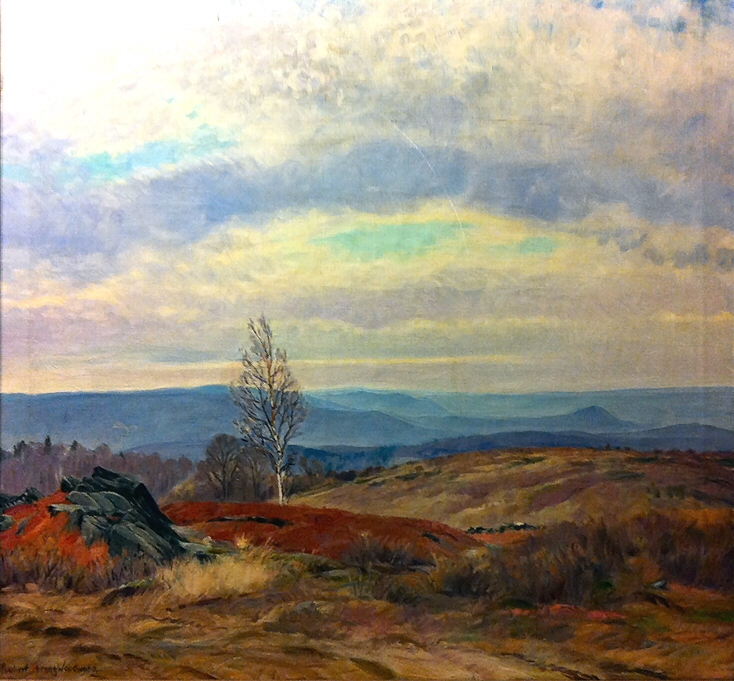
 One of eight paintings that exhibited at the Lyman-Longfellow House
exhibition in December of 1926 without any diary entry in Woodward's Painting Diary.
One of eight paintings that exhibited at the Lyman-Longfellow House
exhibition in December of 1926 without any diary entry in Woodward's Painting Diary.
Unknown Source, Lyman Exhibit, Dec. 1926
"...And then he turns to the beauties and fancy of nature itself, of the great outdoors. Here the artist's fancy is stirred to great heights. There is the cold gray of late November when the last glow of color is seen in the trees. There is the brilliance of autumn when the season is at its richest heights with the luxuriance of red and orange..."
Editor's Note:
The above is a review of Woodward's first "One-man show," held on the second floor ballroom of the residence of Mr. and Mrs. Ronald T. Lyman in Boston. It was the artist's first major showing since his tragic studio fire in 1922. The fire derailed his career for four years and ruined his reputation among the numerous galleries in the region because it left the MacBeth Gallery in New York City without a show two weeks before it was scheduled. The Lyman's are neighbors and friends of Mary "Minny" Eliot, Woodward's most staunch advocate.

 Unknown Source, Lyman Exhibit, Dec. 1926
Though the review above does not name a single painting other than
identifying the painting image accompanying the article, we feel quite certain the writer is commenting on
this painting by specifically mentioning November and "gray" for that matter. The description reminded us of
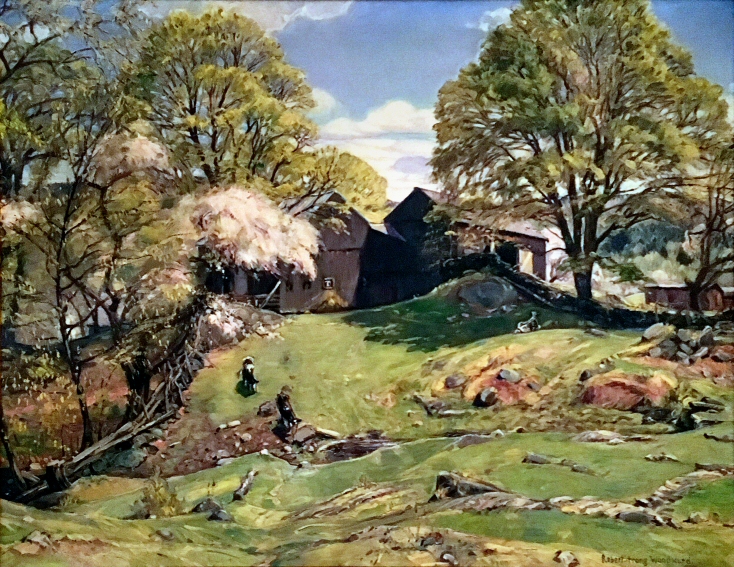
another scene similar to the one being recounted, and that is the painting above named High Pastures.
We have a painting older than November Grey made from the pasture on Burnt Hill in Heath and so it is
not too much a reach. Besides, the solo birch tree in the painting was painted a couple of time suggesting
there was something Woodward liked about the subject.
We continue our notes below in the next
section...
Additional Notes

Boston Post, Dec. 9, 1926
Boston Post, Dec. 9, 1926
"There is a quiet, peaceful and poetic atmosphere in 'The Woods at Night' while 'November Grey,' quite different in type is finely executed."
November Grey was also mentioned in the Boston Post review to the
left. We want to stress the point that only a select few paintings ever get mentioned in two article, from
different newspapers and critics. We would and will call it "well reviewed," and as such leaves us with the
question as to how Woodward could have failed to write a diary comment regarding the work as he was compiling
a diary in the 1940s?
Our question is rhetorical and probably will not be answered with any
certainty. However, if we were not investing the question we would have missed the fact that this painting did
NOT have an artwork page!
New England in November, 1933. Another Novem-
ber scene by the artist. It has similar coloring from the
description of the reviewer, just not as vivid, STILL it
does have golden light in its trees, thus its inclusion.
... Actually there was an artwork page but it did not appear in the alphabetical gallery and it was
incorrectly named leading us to our next topic- gray versus grey. Woodward used both spellings, and if you are
not aware, 'gray' is the preferred American spelling, and 'grey' the British. We tried to see if this is
something Noah Webster, who is the father of American English, changed the spelling of. He did so,
particularly with words with silent letters, i.e. color and colour, but we could not find
one.
Woodward used both in his naming of painting and since we know him to be quite intentional when
it comes to naming his work we believe there is a reason. We have not decoded that reason just yet. We cannot
find any distinguishable pattern or obvious subject or theme. If you would like to take a shot at it, please,
by all means. Just let us know what you came up with.