
Quick Reference
c. 1937
Bennington, VT
Pastel on Board
Landscape
Churches, Buildings
29 X 22
Mass. State College, 1938
Vose Galleries (Boston), 1938 &'39
Lawrence (MA) Art Museum, 1938
Westfield Athenaeum, 1941
Deerfield Valley Artist Assoc., 1941
Mrs. H. G. Young
NA
.png)
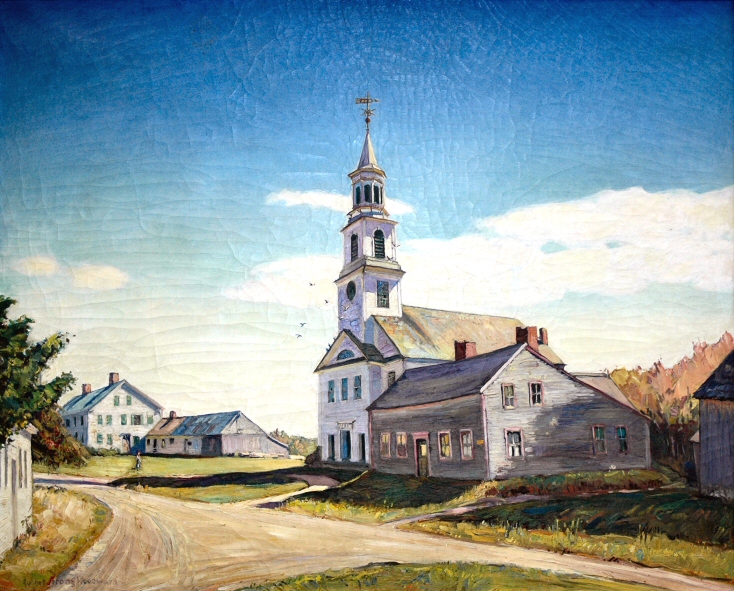
Featured Artwork: The Church at Bennington, Vermont
RSW's Diary Comments


 The artist did not keep a record of his pastel painting he called chalk
drawings.
The artist did not keep a record of his pastel painting he called chalk
drawings.
Painting Diary entry for Autumn Window:
"Painted about 1935 or '36. One of my studio windows in Buckland. Exhibited at Manchester, Vt and elsewhere and bought from Manchester by Mrs. H. G. Young of Greenwich, Connecticut. She also owns chalk drawing of Bennington Church."
Editor's Note:
While we do not believe this pastel painting was part of the Francis P. Garvan Commission, we suspect Woodward traveled to Bennington and probably made the chalk drawing at the scene and used it to paint the oil painting in the studio. Note the autumn coloring of the trees, with the artist far from home, perhaps the temperatures were too brisk to spend a day without shelter close by.
Additional Notes

Let's start by saying that this is the only known, "church-only" painting we
know to be sold by Woodward. Other finished church paintings, such as, East Poultney Church and
Village Church in Winter, nor was the oil painting of this scene,
The Bennington Church, were never sold by the artist and other paintings were churches appear, such
as, Enduring New England, the church is not the subject. As it
is with, The Heart of New England, the central theme is the
typical "New England village center" and what typical village center did not have a church? In fact, even the
painting Village Church in Winter was NOT initially made as a
church painting! Woodward "re-painted" it from an early 1920s painting where the frozen Deerfield River with ice
skaters on it was the subject just for the Garvan Commission. The church was a backdrop and maybe even hosted
the event- of people gathering.
What prompted the artist to paint Enduring New England (which also had a pastel) was the still dirt
road village center of Marlboro, Vermont. The church in the painting which led to the Garvan Commission was, as
is the tradition of many New England villages, was called and is STILL to this day name-- The Marlboro Meeting
House and not "the church." Marlboro Meeting House
Library, Bookplate