
Craquelure
Dear owner of a Robert Strong Woodward oil painting:
In response to your question to me about having your Woodward restored to improve the craquelure I would like to give you my feelings about this condition.
The following is an INTRODUCTORY COURSE IN PAINTING CRAQUELURE 101.

Mona Lisa
I do not!
I think it detracts from the original beauty of a painting and I have had it removed (corrected) by art restorers a number of times in the past. The most well known restorer in my area is the Williamstown Art Conservation Center , connected with the Clark Museum, in Williamstown, MA. It is known world-wide. When we have visited there we have seen "old masters" being worked on.
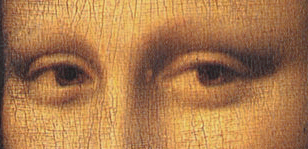
Craquelure in the Mona Lisa
From Wikipedia, the free encyclopedia
In art, craquelure (French: craquelé, Italian: crettatura) is the fine pattern of dense "cracking" formed on the surface of paintings, in particular due to the aging of paints. It is often used to determine the age of paintings and to detect art forgery, as craquelure is a hard-to-forge signature of authenticity.Authentic
Authentic craquelure occurs because paint dries and becomes less flexible as it ages and shrinks. In the case of paintings on canvas, the canvas slackens as it ages as it cannot endure the long-term stress of stretching. Paint at the center of a painting is the least cracked, whereas paint at the edges is the most cracked, or stressed. The precise pattern of craquelure depends on where, when, and under what conditions the picture was painted. Cracks caused by stretching or slackening the canvas are quite different from cracks due to other factors, such as drying and aging of the paint. The paint cracks when the stress upon it is greater than the breaking stress point of the paint layer and the paint will crack approximately at right-angles to the direction of the stress, relieving that stress. In the middle of the picture the cracks tend to run parallel to the short sides. They spread from the middle towards the stressed locked edges, while the cracks starting at the short sides curl round. The stress at the corners is more than double that of the center. There appear to be distinct French, Italian and Dutch "styles" of craquelure.
The craquelure is almost impossible to accurately reproduce artificially in a particular pattern, although there are some methods such as baking or finishing of a painting wherein this is attempted. These methods, however, can get a crack at most uniform in appearance, while genuine craquelure has cracks with irregular patterns. The precise pattern depends on chemical characteristics of pigments used-from the finest light colors to the less perceptible dark, the painting style of the painter, and whether wood or canvas was used as a background. It also furnishes a record of the environmental conditions the painting has experienced during its lifetime, such as temperature and humidity, and can also reveal details about the painting's history of handling, transportation, and restoration.
Induced
Induced craquelure gives new objects such as ceramics and furniture an "antique" look. The effect is achieved by a chemical reaction that results in regular-looking craquelure. The regularity is given by the thickness of the product applied, which can be mixed with bitumen of Judea or oil paints. Flatting and cracking can be replaced by shellac and gum arabic. Art forger Tony Tetro discovered a way to use formaldehyde and a special baking process.
In recent years the modern decor industry has used the technique of craquelure to create various objects and materials such as glass, ceramics, iron. This was made possible by the use of marketing kits that react with the colors used in decorative acrylic colors. The extent of craquelure produced varies according to the percentage of reagent and time of use. To highlight the cracks, glitter powder - usually available in copper, bronze and gold - is used. Mixing different brands of ready-made products to mimic craquelure results in various sizes and patterns of cracks. Software programs are available for creating craquelure in digital photos.

Mount Eqinox In April photographed with a "raking" light to highlight the craquelure
If you should decide to have your painting restored you must realize that it is very expensive. My last painting to have been sent for removal of craquelure (Mount Equinox in April) cost nearly $3,000, and because I was dissatisfied with the result and sent it back for further restoration, it cost an additional $1,000,
My last experience with this procedure has been a learning one. When I complained that craquelure was still visible, the restorers explained to me that the technique for removing craquelure involves removing the painting from the stretcher, applying some sort of glue to the posterior of the canvas and then putting it in a heat press. The glue gets warm and soaks into the canvas and grasps the paint and sticks it down better to the canvas. The procedure works fine. The craquelure really completely disappears. The problem is that the longevity of this correction is unknown. There have not been sufficient years go by, since this technique has been used, to be certain that the correction will last. l prefer to have the painting in pristine condition while I am still around to appreciate it. Hopefully, but I guess uncertainly, it will remain good many years from now.
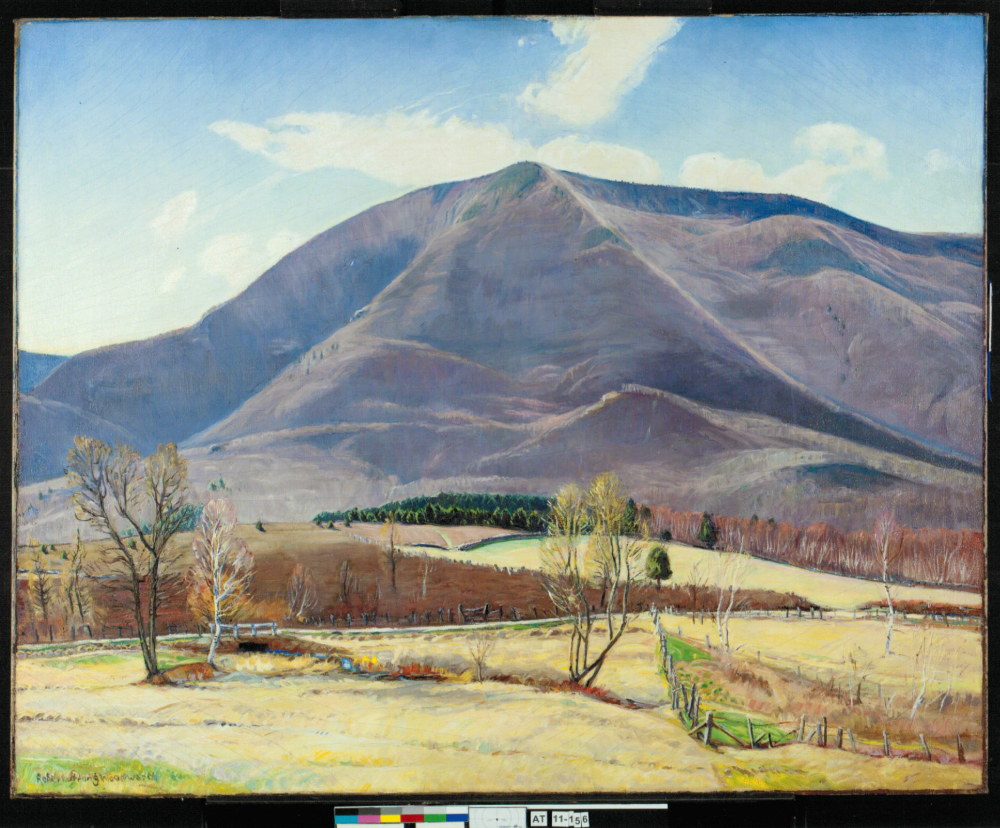
Mount Eqinox In April after restoration
You will have to decide. Do you want your painting to look pristine during your lifetime? Do you want to spend a few thousand dollars to have it so?
I can furnish you with more information about the Williamstown Art Conservation Center if you desire it. And if you decide to have your painting restored you must specifically ask for craquelure removal, otherwise they will restore it in the usual way, (ie. clean it and perhaps "in paint" areas which need it) ... but not work on the craquelure.
I will be interested to know what you decide about having it done to one of your Woodwards and what you think of the results. Your answer will be printed here ... of course with your permission.
MLP
March 2015